


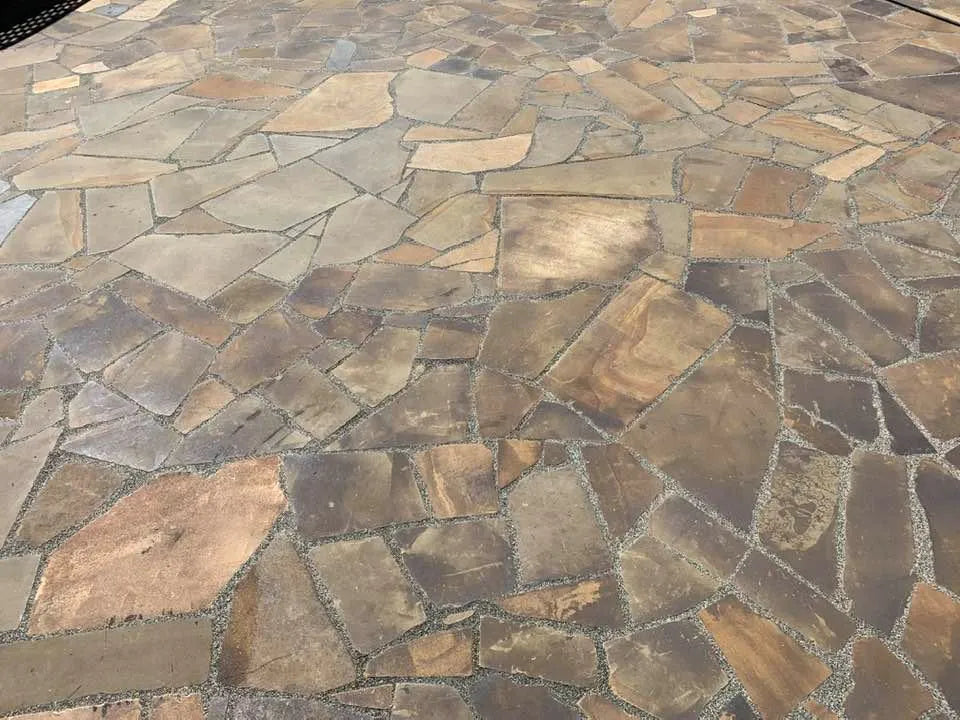
Is Reclaimed Stone Paving Frost-Resistant and Weatherproof?
If you’re weighing up reclaimed paving for a patio, path or driveway, this is probably the question keeping you up at night. British weather doesn’t do us any favours. One week it’s baking, the next it’s -4°C with a hard frost, and your new paving is sat outside taking all of it.
The short answer is yes, good reclaimed stone paving, particularly reclaimed York stone, is frost resistant and weatherproof. It’s been doing exactly this job for well over a century already. But there’s more to the story than a quick yes, and it’s worth understanding why before you buy, because not every reclaimed stone performs the same way.
We’ll walk through what frost damage actually is, why York stone handles it so well, and what you need to get right during installation so your paving stays put for the next hundred winters too.
What Actually Causes Frost Damage in Paving?
Here’s the simple version. Stone, like most materials, has tiny pores in it. Water gets into those pores when it rains. When the temperature drops below freezing, that water turns to ice.
Ice takes up more space than liquid water, roughly 9% more. So as it freezes inside the stone, it pushes outward. Do that once, and nothing much happens. Do it fifty times over a winter, year after year, and you start to see cracking, flaking or crumbling at the surface. This is called the freeze-thaw cycle, and it’s the main enemy of any outdoor paving in the UK.
Think of it like an ice cube tray left in the freezer a bit too full. The water expands as it freezes and the tray bulges. Paving stone works the same way, just much slower and on a smaller scale.
The stones most at risk are the porous ones, the ones that soak up water like a sponge. The stones that hold up best are dense, low-porosity materials that don’t let much water in to begin with.
Is York Stone Naturally Frost Resistant?
Yes, and this isn’t marketing spin. York stone is a type of sandstone, specifically a Carboniferous gritstone, quarried in Yorkshire and Lancashire for hundreds of years. It’s the stone you’ll see on pavements, courtyards and railway platforms all over the north of England, some of it still going strong after 150 years or more.
What makes it good for this job is its structure. The grains are tightly bound together, which gives it a low to medium porosity compared with softer stones like some limestones. Water doesn’t sit and soak into it the way it would with a more absorbent material. Combine that with its natural durability and slight surface texture, which also gives it excellent slip resistance in wet or icy conditions, and you’ve got a stone that was practically built for outdoor life in Britain.
It’s also worth saying that York stone was never really designed for paving in a lab somewhere. It earned its reputation the hard way, through generations of Victorian and Georgian streets, farmyards and mill towns putting it through the wringer every winter.
Why Reclaimed York Stone Has Already Passed the Test
This is the bit people often miss, and it’s actually the strongest argument in favour of reclaimed over new.
Every slab of reclaimed York stone we sell has already been outdoors for decades, sometimes over a century. It’s been rained on, frozen, thawed, walked on and driven over more times than anyone could count. If a piece of stone had a weakness or a hidden flaw that frost would exploit, it would have shown up by now. What’s left is the stone that survived.
It’s a bit like buying a second-hand car with 100,000 miles on the clock versus one straight off the production line. The older one has already proven it doesn’t have a fault waiting to appear. You know what you’re getting, because it’s already been tested by the harshest inspector there is: the great British winter.
That’s part of why reclaimed paving from places like old mill yards, farm buildings and demolished streets is so sought after for period properties. It’s not just about the character and the weathered patina, it’s about buying material with a genuine track record.
If you want to see this history for yourself, our yard in Stoke-on-Trent is full of reclaimed stone with decades of outdoor life already behind it, and you’re welcome to come and have a look before you buy.
New vs Reclaimed: Which Is More Weatherproof?
We stock both new and reclaimed York stone paving, and honestly, in terms of raw frost resistance, they’re both good options. The stone itself hasn’t changed chemically just because it’s a few decades older.
Where they differ is in the details:
New York Stone
New stone gives you consistent thickness, cleaner edges and a more uniform colour. It’s a good choice if you want a crisp, contemporary finish or you’re working to tight tolerances on a large area.
Reclaimed York Stone
Reclaimed stone gives you that already weathered look from day one, along with the reassurance that it’s already survived decades of British winters. It also tends to suit older or period homes far better, since the tone, texture and slight irregularity match the property rather than looking bolted on.
Neither is the “safer” choice when it comes to frost. The real deciding factor is usually the look you’re after and the age of the property you’re paving.
Getting the Installation Right Matters Just as Much as the Stone
Here’s the thing nobody likes to hear: even the most frost resistant stone in the world will crack, lift or heave if it’s laid badly. Most paving failures in winter aren’t actually the stone’s fault at all. They’re an installation problem.
A few things make the real difference:
Drainage and Fall
Paving needs a slight fall, usually around 1:80, so water runs off rather than pooling on the surface. Standing water is what causes most frost problems, because it gives the freeze-thaw cycle something to work with in the first place.
A Proper Sub-Base
A well-compacted sub-base stops water sitting underneath the slabs and freezing there, which is what causes frost heave, where the ground itself pushes the paving upward.
Jointing
Open or poorly filled joints let water track down between the slabs and sit against the edges, which is often where cracking starts. A good jointing compound keeps water where it belongs, on the surface, where it can drain away properly.
Get these three right and pretty much any decent stone, new or reclaimed, will handle a British winter without complaint.
If you’re also weighing up whether reclaimed paving can cope with cars and foot traffic on top of the weather, our guide on whether reclaimed paving can be used for driveways and high traffic areas covers that in more detail.
Other Reclaimed Paving Worth Considering
York stone isn’t the only reclaimed option that stands up to UK weather. Reclaimed cobbles and granite setts are another popular choice, particularly for driveways, and granite in particular is about as dense and frost resistant as natural stone gets.
If you’re still deciding which material suits your project, it’s worth reading up on what reclaimed York stone actually is and why it’s so popular, or if you’re set on sourcing it, our guide on where to buy reclaimed York stone paving in the UK is a good next stop.
The Short Version
Reclaimed York stone paving is frost resistant and weatherproof. Its low porosity and dense structure mean it doesn’t absorb enough water for freeze-thaw cycles to cause much damage, and every reclaimed slab has already proved that by surviving decades outdoors. The look you choose, new or reclaimed, comes down to style rather than durability.
Just make sure whoever lays it gets the drainage, sub-base and jointing right, because that’s where most winter paving problems actually start. If you’d like to see and feel the stone before you commit, pop down to our yard in Stoke-on-Trent, or browse our full range of York stone paving online.
Frequently Asked Questions
Does reclaimed York stone need sealing to survive winter?
Not necessarily, but it can help. York stone’s natural low porosity means it copes well with frost on its own. Sealing mainly protects against staining and can offer a bit of extra defence against water absorption, but it isn’t essential for frost resistance the way it might be with a more porous stone like limestone.
Can reclaimed paving crack in freezing temperatures?
It’s possible, but it’s rare with a genuinely dense stone like York stone, and it’s usually down to poor installation rather than the material itself. Trapped water under the slabs or in the joints is almost always the real culprit when cracking happens.
Is reclaimed stone paving more prone to frost damage than new paving?
No. Age doesn’t make stone more porous or more fragile. If anything, reclaimed stone has a proven track record of handling frost, since it’s already survived multiple winters outdoors before it ever reaches your garden.
What’s the difference between frost resistant and frost proof?
Frost resistant means the material copes well with freeze-thaw cycles and won’t easily crack or flake. Frost proof suggests total immunity, which isn’t really achievable with any natural stone. York stone falls firmly into the frost resistant category, and with decent installation, that’s more than enough for UK conditions.
Is reclaimed York stone suitable for a driveway, not just a patio?
Yes, provided it’s laid at the correct thickness for vehicle loads and on a proper sub-base. Thicker reclaimed slabs, often salvaged from old industrial or civic sites, are well suited to driveway use. Our guide on reclaimed paving for driveways and high traffic areas goes into the specifics.

